 By
·
4 minute read
By
·
4 minute read
4 meals a day weight loss plan
Published: 2026-02-20
If you are searching for a 4 meals a day weight loss plan, here is the honest truth: four meals is not magic. But it can be a very effective structured eating schedule for weight loss if it helps you stay consistent, manage hunger, and avoid random grazing.
Big picture: you lose fat by maintaining a calorie deficit over time, and any meal frequency can work if it supports that deficit. A four meals diet plan just makes that process easier for many people.
Executive summary
A four meals diet plan works best when it does three things: keeps you in a calorie deficit, distributes protein across the day, and reduces late-day overeating.
My take: for busy people who get hungry between meals, four meals is often more realistic than forcing long gaps. If you are not hungry between meals, you might do better with three meals.
Practical target: aim for 3 to 4 hours between meals, build each meal around protein plus high-volume plants, and keep the last meal earlier rather than turning it into a late-night snack routine.
Why four meals can help with weight loss
A good 4 meals a day weight loss plan is really a behavior tool. You are using structure to make the basics easier: fewer impulse snacks, fewer huge hunger spikes, and less decision fatigue.
If you keep asking “how many meals to lose weight,” this is the simplest answer: pick the number that helps you control appetite and stay consistent. For many people, four meals hits a sweet spot between structure and flexibility.
A quick rule that works in real life: if you arrive at dinner ravenous and overeat, add a protein-forward afternoon meal. If you are not hungry all day and forcing meals, consider three meals instead.
Another lever that pairs well with four meals is protein. Higher-protein patterns often improve appetite control, and spreading protein across meals tends to feel easier than saving it all for dinner.
If you want a simple structure, build each meal around protein plus plants (vegetables, fruit, beans, whole grains), then add fats or carbs based on your energy needs.
Structured eating schedule and timing
Your structured eating schedule for weight loss should feel boring in a good way. Same meal windows most days, plus enough flexibility to live your life. Consistency beats perfection.
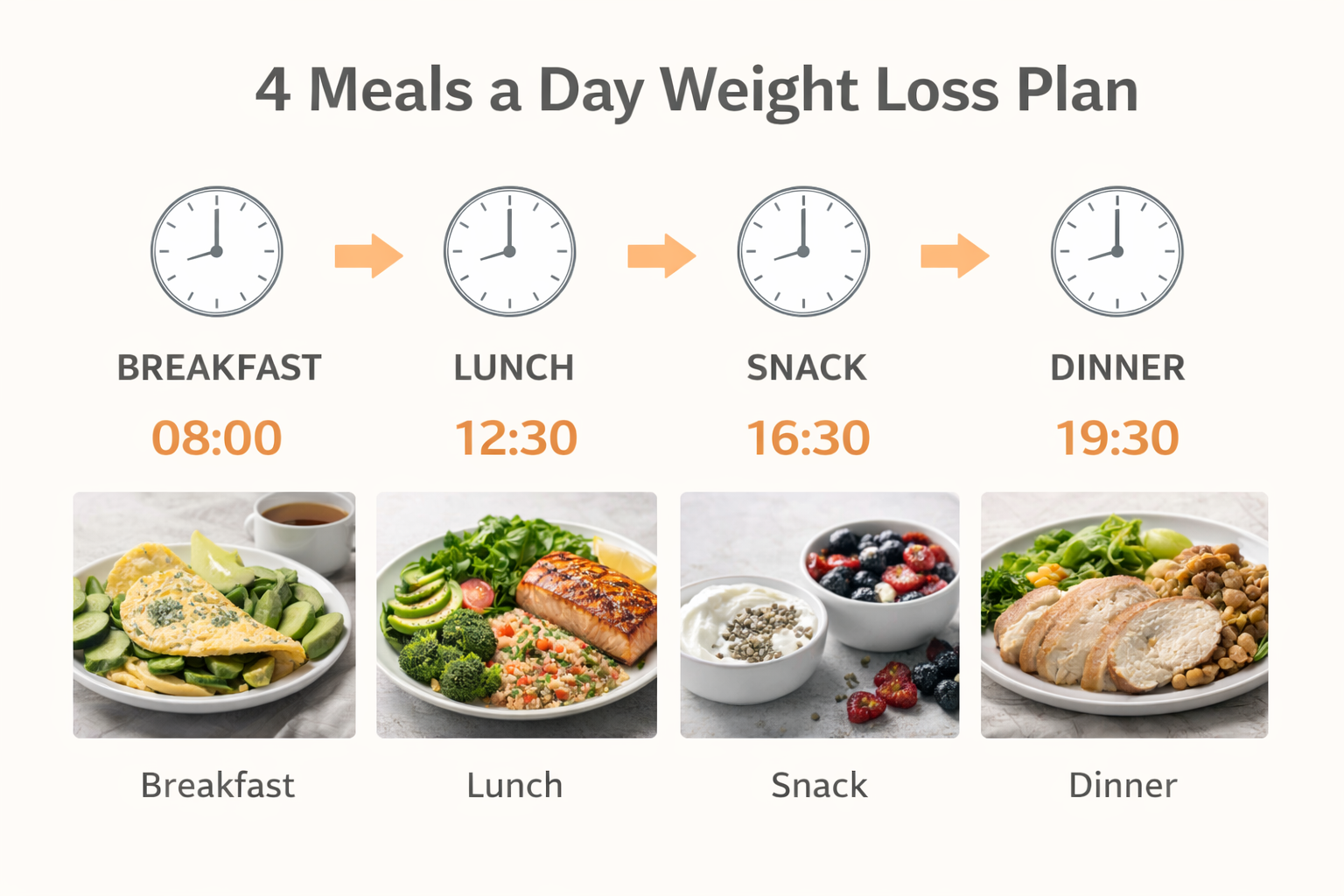
A simple four-meal schedule looks like this: breakfast, lunch, afternoon meal (snack or mini-meal), and dinner. Keep meals roughly 3 to 4 hours apart so you arrive at each meal slightly hungry, not ravenous.
If you train, place the snack or mini-meal around training. If you train after work, the afternoon meal can prevent “I will eat everything now” dinner energy.
Tips that make the plan work
The difference between a plan that looks good and a plan that works is usually boring consistency. These are the highest-impact tweaks I see again and again.
- Keep meal times consistent on weekdays. Then be flexible on weekends without turning it into chaos.
- Make protein non-negotiable in at least 3 of the 4 meals if hunger is your main issue.
- Build volume with vegetables and fruit. This makes a calorie deficit feel easier.
- Keep ultra-processed “hyper-palatable” foods as an occasional choice, not a daily default.
- If you crave sweets at night, check dinner protein, dinner volume, and the size of your afternoon meal first.
- If progress stalls for 2 to 3 weeks, adjust one variable only (portions, snack size, or meal timing).
If you want a simple check: your appetite should feel manageable most days. If you are constantly white-knuckling it, the plan is too aggressive or too low in protein and fiber.
FAQ
| Question | Answer |
|---|---|
| How many meals should I eat to lose weight? | There is no single best number. Fat loss comes from a sustained calorie deficit. Choose a meal pattern that helps you stay consistent. Four meals often works well for people who get hungry between meals or who tend to overeat at dinner. |
| Is four meals a day better than eating six small meals? | Not automatically. If six meals makes you think about food all day, it can backfire. Four meals often feels simpler and easier to stick to. |
| Do I need to count calories on a 4 meals a day weight loss plan? | No. Many people succeed using a consistent schedule, protein-forward meals, minimally processed foods, and portion control. If you are not losing for a few weeks, a short tracking period can help you spot hidden calories. |
| Should I add a bedtime snack as a fourth meal? | Usually no. Most people do better keeping the last meal earlier. If you are truly hungry at night, dinner may be too small or too low in protein and fiber. |
| What is the simplest way to start tomorrow? | Pick four meal times. Repeat two go-to breakfasts and two go-to lunches for a week. Build dinners around protein plus vegetables. Keep the snack protein-forward. |
Health360: Weight & Anti-Age
If you want help turning this into an actual routine (reminders, meal ideas, and habit tracking), you can use Health360: Weight & Anti-Age.
Android app: Health360 on Google Play
iOS app: Health360 on the App Store
Explore more: Healthy and Elegant Products | Healthy and Elegant Blog
Medical disclaimer: Health360 provides educational information only. It is meant to support general health and help build good habits. It is not medical advice, and it does not diagnose, treat, or cure any medical conditions. Always consult with your doctor or a licensed healthcare professional for personal medical advice.
References
Sources are linked for transparency. This article is educational and not a substitute for medical care.
- NHLBI (NIH): Overweight and obesity treatment (calorie reduction, activity, lifestyle changes). Read
- JAMA Network Open (2024): Systematic review and meta-analysis on meal timing strategies. Read
- Nutrition Reviews (2015): Meta-analysis on meal frequency and body composition. Read
- American Journal of Clinical Nutrition (2015): Review on protein in weight loss and maintenance. Read
- NIH (NIDDK, 2019): Controlled trial summary on ultra-processed foods and overeating. Read